
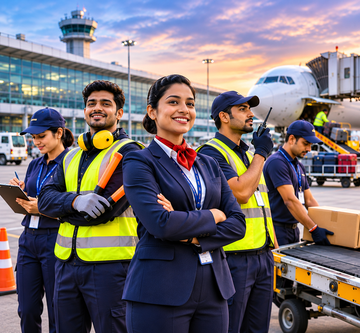
Ask most people about aviation careers and they’ll name pilots first, then cabin crew. Yet much of the real work happens on the ground: on the apron, where aircraft are guided and loaded, and behind the check-in desk, where travellers start their journeys. A surprising number of these roles don’t require a degree or any flying experience. If you’re interested in airports but have no desire to fly the plane, you may find a career here that suits you well.
Why ground roles matter
Flights run to a tight schedule, and a small delay can spread. The plane has to be guided onto its stand. Bags and passengers have to go on. Fuel and catering have to arrive. The cabin has to be cleaned before the next departure. If one of those runs late, the others feel it. So the people on the ground matter more than most travellers ever notice.
An article on the Airports Council International (ACI) blog, written by the head of the Hong Kong International Aviation Academy, describes a gap between the supply of and demand for aviation workers in its workforce strategy insights. The roles it covers include ground handling, ramp operations, air cargo and airport management, so there are more options than most people expect.
What ground handling staff do
Ground handlers, often called ramp agents, spend most of their shift on the apron. They guide planes onto their stands, load and unload bags and cargo, drive ground equipment and get the aircraft ready to leave. The UK Skills England occupational map describes it as a closely coordinated team job at airports and other aerodromes.
It’s physical work, and you’ll spend much of it outside. Shifts might start before dawn or run past midnight. Flights don’t wait for daylight.
Passenger service and baggage roles
Passenger service agents work at check-in desks, boarding gates and arrival halls. They sort out tickets and seat changes, help with missed connections, and look after passengers who need extra support. Baggage handlers take bags from the terminal to the aircraft and back, checking the tags and scans that get each one onto the right flight.
Cargo careers
Air cargo carries almost anything, from medicines and fresh food to heavy machinery. Cargo staff check shipping paperwork, weigh and sort freight, prepare loads and follow goods through the system. If you enjoy detail and routine, this could be a good match. One wrong label or missing document can hold a shipment up for days. The skills also carry over to freight forwarding, customs paperwork and warehouse work.
Who employs ground staff
Many people assume ground staff work directly for the airport. Often they don’t. Some are employed by airlines. Others work for specialist ground handling companies that look after several airlines. Flying magazine reported in 2025 that the largest ground handling companies were hiring across their networks, and that airlines also advertised airport jobs. When you apply, check who the employer is and where the job is. Someone in an airline uniform may actually work for a contractor.
Skills that help in ground and cargo roles
Employers in this area tend to look for a mix of practical and people skills:
- Physical fitness and stamina for long shifts on the apron
- Safety awareness, since working around aircraft and vehicles means following strict rules
- Clear communication, especially over radios and in noisy places
- Accuracy with documents and systems for bags, cargo and flight records
- Reliability and punctuality, because each task depends on the one before
Many of these can be learned on the job. Some employers would rather hire someone with a good attitude and a willingness to learn than someone with years of experience.
How a course can help you start
A course gives you a head start before you apply. At Skygate Aviation Academy in Calicut, you can choose a BBA in Aviation and Airport Management, a one-year diploma in airport management, or a six-month option. The courses introduce the basics of how airports operate, so you can see where ground work fits in. The one-year diploma includes practical airport exposure and training in airport operations, and it lists ground handling among the careers students can explore. You can compare all the options on our aviation courses page.
If you’re unsure how the teams fit together, read our article on airport departments and their roles. For the personal qualities that help in any role, see 5 skills to succeed in airport management.
Frequently asked questions
Do I need a degree to work in ground handling?
Usually not, depending on the employer. Many entry-level ground handling and cargo jobs don’t ask for one. Employers look for fitness, reliability, safety awareness and a willingness to learn. Some specialist or supervisory roles need more training.
Is ground handling a good career for women?
Yes. The work is open to anyone, and some airports and ground handling companies employ women in these roles. What matters is your skill, your fitness for the job and your commitment to safety.
What is the difference between ground handling and airport management?
Ground handling is hands-on work at the aircraft and in the terminal, such as loading, guiding and helping passengers. Airport management is about planning and running the airport as a whole. A management course shows the bigger picture, while a ground role gives you practical experience.
Do ground staff work night shifts?
Often. Airports run around the clock, so ground and cargo teams work early, late and night shifts, and weekends and holidays too. Ask about the shift pattern before you apply.
Can a course help me get a ground handling job?
A course can’t promise a job. It does teach how airports operate and why safety rules matter, which many employers value. It also gives you something concrete to talk about in an interview, and it helps you decide which role suits you.
To ask about the courses or book a visit, email info@skygateaviation.in or use our contact page.