
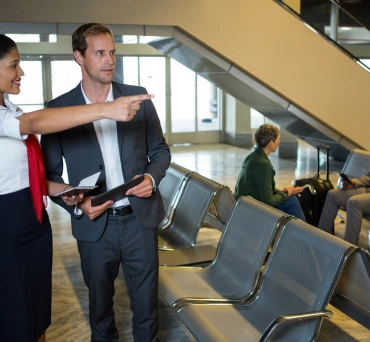
Walk into any busy airport late at night, and you’ll find it wide awake. Flights leave for the Gulf, for Delhi, for Singapore at hours when the rest of the city is asleep, and every one of them needs a whole crowd of people to get it off the ground. Most travellers only ever notice a few of them: the check-in counter, the security line, the gate.
What we don’t see is everyone else. While you were hunting for your boarding pass, someone decided which gate your flight would park at. Someone loaded your suitcase. Someone made sure the aircraft could leave on time. An airport only works because a lot of people, in a lot of different teams, are doing their jobs at the same moment.
If you’re thinking about a career in Airport Management, it helps to know who those people are before you sign up for anything. You’ll get a real picture of the work, and a sense of which part of it might suit you. It’s also the easiest way to judge what an Airport Management Course in Calicut should actually be teaching you.
So let’s walk through the main airport departments and their roles, one at a time.
The 10 Main Departments in an Airport
1. Airport Operations
Think of operations as the airport’s nerve centre. This team keeps an eye on everything at once: which flights are coming in, which gates are free, where the queues are building up, and what happens if the weather turns.
On a normal day, they’re assigning gates and parking stands, passing updates between airlines, ground handlers and security, and keeping the day on schedule. On a bad day (a delay, a diversion, a monsoon storm over the runway), they’re the ones holding it all together.
The people who do well here stay calm under pressure. They tend to spot a problem before anyone else does.
2. Passenger Services
These are the people travellers actually remember. A passenger service agent checks you in, verifies your documents, weighs your bag, hands over your boarding pass and, a little later, scans you through at the gate.
They also look after passengers who need extra help: elderly travellers, children flying alone, anyone who needs a wheelchair. And when a flight is delayed or cancelled, they’re the ones rebooking a long queue of unhappy people.
If you genuinely enjoy dealing with people, and can keep smiling at 5 a.m. during the Gulf rush, this is where a lot of airport careers begin.
3. Ground Handling
The moment an aircraft lands, the clock starts. On short routes,s it may need to be unloaded, cleaned, catered, fuelled, reloaded and boarded again in well under an hour. Ground handling is the team that plans and coordinates all of that.
They don’t do every job themselves. They make sure the cleaners, caterers, fuel crew, ramp staff and baggage team turn up at the right time and in the right order. One slow link and the departure slips. So does every flight that aircraft is meant to operate after it.
You’ll be on your feet all shift. If you like hands-on work that never really slows down, that’s a plus, not a problem.
4. Baggage Handling
Ever wondered where your suitcase goes after it disappears behind the check-in counter? It goes to this team.
Baggage handlers sort every bag by flight, load it into the hold, unload it at the other end and get it onto the belt. Bags for connecting flights have to be moved across quickly. And when a bag does go missing, this is the department that tracks it down.
It’s careful, physical work. Accuracy matters more than speed, though you’ll need plenty of both.
5. Customer Service
Passenger services get you onto the plane. Customer service helps with pretty much everything else.
They’re at the information desk telling a first-time flyer where Gate 4 is. They’re making announcements, explaining why a flight is late, handling complaints and helping someone find the phone they left at security. Not the most glamorous job, maybe, but for a nervous traveller, they can make the whole trip.
Patience helps. So does a clear voice. But the real skill here is listening.
6. Ramp Operations
The ramp (also called the apron) is where aircraft park, and it’s one of the busiest spots in the whole airport. Ramp staff guide aircraft into their stands, drive tugs and belt loaders, position the stairs and help with pushback when it’s time to go.
Jet engines, moving vehicles and tight deadlines all share one small space. So the safety rules out here aren’t suggestions. If you like working outdoors and you’re the type who follows procedure every single time, you’d do well on the ramp.
7. Safety and Security
Every passenger, every bag and every staff member gets checked before entering a secure area. That’s the security team’s job, along with guarding restricted zones and supporting the response if there’s ever an emergency.
You can’t be “mostly” alert in this role. It takes real discipline. But it’s also one of the most respected departments in any airport, because without it, nothing else can happen.
8. Cargo Operations
A lot of what flies isn’t people. Medicines, electronics, fresh produce, online shopping parcels and business shipments all travel in the cargo hold, and the cargo team makes sure they arrive.
The work is heavy on paperwork: shipping documents, coordination with customs and freight companies, safe storage (some goods have to stay cold) and getting everything loaded on time. If logistics or supply chains interest you, give this one a serious look.
9. Airline Coordination
Most students assume the airport and the airline are the same company. They aren’t. They still have to work as one, and airline coordination is the team that makes that happen.
They pass on schedule changes, coordinate boarding and delays, and check that whatever the airline needs is actually being done on the ground. Expect a lot of calls, radio messages and quick decisions. Strong communicators tend to love it.
10. Airport Administration and Management
Everyone else is busy with today’s flights. Administration is thinking about next month and next year: staffing and rosters, training, reports, budgets and how to make the airport run better.
Most people don’t start here. They get here after a few years in operations or passenger services, which is one more reason to understand the other nine first.
So, Which Department Suits You?
Now that you know the airport departments and their roles, start with what you enjoy and work backwards.
- Love talking to and helping people? Look at Passenger Services or Customer Service.
- Like fast, hands-on teamwork? Ground Handling or Ramp Operations.
- Good with accuracy and organisation? Baggage Handling or Cargo Operations.
- Enjoy coordinating and solving problems? Airport Operations or Airline Coordination.
- Disciplined and alert? Safety and Security.
- See yourself planning and leading? Administration and Management.
How Skygate Prepares You for These Departments
Reading about these jobs won’t get you hired, of course. Training will. This is how what you learn in Skygate’s Airport Management programmes lines up with the departments above:
- GDS booking software (Galileo on all courses, plus Amadeus on the 1-year diploma and BBA): used in passenger services, airline coordination, reservations and ticketing.
- Airport training (1-year diploma and BBA): prepares you for operations, ground handling, ramp and baggage work.
- First aid training: useful in safety and security, and whenever a passenger needs help.
- Communicative Hindi, English and a foreign language: the backbone of customer service and passenger services.
- Mock interviews, fitness training, and a uniform and grooming kit: for every department, starting with your first interview.
- Logistics add-on (1-year diploma and BBA): a route into cargo operations.
There are three ways in, depending on how much time you have:
- 6-Month Diploma in Airport Management to start working fast
- 1-Year Diploma in Airport Management for two diplomas, both GDS systems and airport training
- 3-Year BBA in Aviation and Airport Management if you want management roles later
All three are open to Plus Two students from any stream.
What Skills Do You Actually Need?
Honestly, airports hire for attitude as much as for marks. Whichever department you end up in, recruiters usually look for:
- Clear, confident communication (good English, and another language or two is a bonus)
- Being comfortable working in a team
- Good time management, because flights don’t wait
- Patience with tired or upset passengers
- Basic computer skills
- A neat, professional appearance
- Staying calm under pressure
Nobody’s born with these. You pick them up through practice, role-plays and someone telling you what you got wrong. That’s what a good Airport Management Course in Calicut should be giving you. Notes alone won’t do it.
Where Can an Airport Management Course Take You?
After the course, most students start in entry-level roles such as:
- Airport Operations Assistant
- Passenger Service or Customer Service Agent
- Ground Staff or Ground Handling Executive
- Ramp and Baggage Operations Staff
- Airline Support Staff
- Cargo and Logistics Executive
- Reservation and Ticketing Executive
- Travel and Tourism roles
Your first job is rarely your last one. With a few years of experience, people move up into supervisor, duty manager and administration roles. What’s open to you at the start will depend on the airport, the airline and what each employer is looking for.
Choosing the Right Aviation Institute in Calicut
There are quite a few institutes to choose from, and they aren’t all the same. Before you pay any fee, ask a few straight questions:
- Does the syllabus actually cover the airport departments, or is it mostly theory?
- Will I get practical training in communication, grooming and passenger handling?
- Have the trainers worked in the aviation industry themselves?
- Do you help with interview preparation and placements?
- What’s the exact duration, fee and eligibility?
A good Aviation Institute in Calicut won’t mind you asking. If they dodge the questions, that tells you something too.
Start Your Airport Management Journey with Skygate Aviation
If you’ve read this far, you probably have a department or two in mind already. Good. That’s the hard part done.
At Skygate Aviation Academy in Eranjipalam, Kozhikode, our Airport Management programmes are built around the jobs you’ve just read about. You’ll learn the GDS booking software airlines use (Galileo, plus Amadeus on the longer courses), first aid, and Hindi, English and a foreign language. The 1-year diploma and BBA add hands-on airport training. And you’ll sit mock interviews until the real one feels like just another practice round. There’s a free uniform and grooming kit too, and placement help once you finish.
Looking for an Aviation Institute in Calicut or an Airport Management Course in Calicut? Call or WhatsApp us on +91 9946 066 602, or drop in and we’ll help you work out which department and which course fits you.
Contact Skygate for course details, eligibility and admissions
Frequently Asked Questions
How many departments does an airport have?
It varies by airport, but most of the work falls into about ten main areas: operations, passenger services, ground handling, baggage, customer service, ramp, safety and security, cargo, airline coordination and administration. Bigger airports often split these into smaller teams.
Which airport department is best for freshers?
Passenger services, customer service and ground handling are the usual starting points. You’ll pick up communication and operational experience quickly in all three.
What’s the difference between ground handling and ramp operations?
Ground handling is the whole job of getting an aircraft ready between flights. Ramp operations is the hands-on part of it that happens right next to the aircraft, like marshalling, loading and pushback.
Is Airport Management a good career option?
It is if you enjoy working with people and like a fast-moving workplace. The course can lead to jobs with airports, airlines, ground handling companies, cargo firms and travel agencies.
Can I work in an airport after Plus Two?
Yes. Entry roles in passenger services, customer service and ground handling are open to trained Plus Two students. At Skygate, students from Science, Commerce or Arts can all apply.
Which Skygate course should I choose?
The 6-month diploma is the fastest route to a job. The 1-year diploma adds a Travel & Tourism diploma, Amadeus training and airport training. The 3-year BBA adds business management for those aiming at management roles.
Where can I join an Airport Management Course in Calicut?
Skygate Aviation Academy offers 6-month and 1-year diplomas and a 3-year BBA in Aviation and Airport Management at Eranjipalam, Kozhikode. Call +91 9946 066 602 for details.